
International relocation in 2026 involves complex costs that go beyond simply moving your belongings, requiring careful planning to avoid financial surprises.
- Costs vary between 1800-3000 euro for Romania-Germany, influenced by volume, distance and type of transport chosen
- Plan your move 2-3 weeks in advance to avoid weekend and peak season surcharges
- Ask clear questions about included services, hidden costs and insurance before signing the contract
- Pack small items yourself and use standard boxes to reduce extra costs
- Choose between dedicated transportation (fast but expensive) and groupage (economical for small volumes) depending on your budget
The success of an international relocation depends on the balance between budget and quality of service, and being properly informed about all cost factors helps you make smart financial decisions.
How much will an international relocation cost on average in 2026?
In 2026, the price of an international relocation is mainly calculated based on volume, distance, and type of transport. For the Romania–Germany route, the cost often ranges between €1,800 and €3,000 when you choose dedicated express transport, and groupage options can reduce the budget for smaller volumes.
The cost of international relocation can vary significantly depending on several important factors. For a move from Romania to Germany, for example, prices range from €1800 to €3000 for a dedicated express shipment with a maximum volume of 18 cubic meters. This may seem a considerable amount, but it is only part of the total costs.
When planning an international relocation, we need to consider not only the transportation of goods, but also other essential aspects. In the case of local moves, rates for transporting furniture range from 75 to 100 lei per hour, plus about 50 lei per hour for each worker involved. Cross-border moves, however, incur additional costs. Also, if you want to take your pets with you, you will face obligations such as microchipping and certain vaccinations, which can add up to considerable sums. In addition, when renting a home abroad, you may be asked to pay several months' rent in advance or a security deposit.
In this guide, we will take a detailed look at all the factors that influence the cost of an international relocation in 2026. We will discuss the volume of goods, the distance traveled, the types of services available, and strategies you can use to save money without compromising the quality of your moving experience.

What does international relocation include and why does it cost?
International relocation involves much more than simply moving goods from one country to another. The final price is influenced by multiple components that together make up the total cost of this experience.
Transportation of staff and goods
Transportation is at the heart of any international relocation. Specialized companies offer a variety of options, from ground, air or sea transportation, depending on the destination and urgency. For express removals, the price includes both the actual transportation and the number of kilometers to the destination. For groupage transportation, the cost is calculated according to the volume and quantity of goods transported. A complete removal can take between 3 and 45 days, depending on the volume and weight of the goods, the distance traveled and the time of year.
Packaging and handling services
Professional packing and handling ensures the safety of the items during transportation. Firms use special materials: dedicated boxes, wooden crates for valuables, special beds for furniture, bubble wrap, stretch wrap and bubble wrap with cardboard. Special archive boxes are used for important documents. The costs for packing and unpacking services vary between 200 and 500 lei, depending on the volume and specificity of the goods.
Temporary accommodation and rent in advance
During relocation, a temporary accommodation solution is often needed. Platforms such as 'A Roof' offer support in identifying vetted accommodation for people in transit. When renting accommodation abroad, advance rent or a security deposit should be considered.
Administrative costs and customs duties
Customs duties are a significant cost in the international relocation process. They are taxes levied on goods crossing borders and collected by customs authorities. Their amount depends on the type of goods, the HS (Harmonized System of Classification) code, the value of the goods and trade agreements between countries. There are some exceptions: parcels marked as gifts worth less than €45 and purchases not exceeding €150 are exempt from duty. In addition, the VAT applied varies between countries and can be 0%, 10%, 20% or more.
How to calculate the price of an international relocation
The final price of moving abroad depends on several factors that need to be carefully assessed. Specialized firms use specific methods to calculate the costs, taking into account the particularities of each relocation.
Total volume and weight
Correct volume calculation is the basis for an accurate cost estimate. Many companies provide online volume calculators for the most accurate assessment of the items to be moved. The size of furniture directly influences the price, as bulky items require more space and therefore more fuel. An important aspect to keep in mind is that the same volume of furniture can have different weights, which leads to the need to use different classes of trucks. This is reflected in different fuel consumption and therefore in the final price.
Distance and chosen route
Distance traveled is one of the most important factors in determining cost. The longer the distance, the higher the cost, as more fuel and time are needed. For longer routes, there are also mandatory downtime periods for drivers, which influences the total delivery time. The destination itself can also be an important factor, as some locations are more expensive than others.
Type of transport: dedicated or groupage
Dedicated (full) transportation means that the entire capacity of the vehicle is reserved exclusively for the goods of one customer. The truck drives directly from the loading point to the destination, without intermediate stops. Advantages include shorter delivery time and reduced risk of damage. Groupage transport, on the other hand, involves combining the goods of several customers in the same vehicle, with the customer paying only for the space and weight occupied by his own goods. This option is more economical for smaller volumes.
Additional contracted services
The final cost may also include additional services such as packing and handling, which are essential to protect your goods during transportation. Charges for assembling and dismantling furniture vary according to complexity. There may also be costs for insuring the goods, depending on their value and the level of protection desired. Some companies also offer temporary storage services, which add extra costs to the final price.
What questions to ask the removal firm before signing?
Before signing a contract with an international removal company, it is essential to ask the right questions to avoid unpleasant surprises. Talking directly to the company's representatives will give you valuable information about the services on offer and the terms and conditions of the contract.

What services are included in the offer?
Relocation companies offer different service packages, from simple transportation to complete solutions. First of all, clarify whether the company only handles the transportation of goods or also offers packing, loading, unloading, disassembly and furniture assembly. Also, ask about the packing materials used - professional companies use specialized materials such as triple-pleated bubble wrap, textile covers and furniture blankets. This way you'll know exactly what services are included and what to expect.
Are there hidden costs or extra charges?
Hidden costs can quickly appear, making the move much more expensive than you expect. Ask for a detailed quote that includes all possible charges, including extra labor, charges for longer distances or extra time. Check the overtime charging policy and make sure you understand how these costs are calculated. Negotiate a fixed price that includes all necessary services to avoid unpleasant surprises. Serious companies like IRS Relocation offer "clear and transparent costs with no hidden fees".
What types of insurance are offered?
An important issue is insuring your goods during transportation. Ask what type of insurance the company offers, what it covers and when it applies. Many companies offer customers insurance against damage to fragile, valuable and sensitive items during transportation. Check whether this service will increase the total cost of the move and ask for proof of the policy before loading.
What is the policy in case of delay or damage?
Inquire about the company's policy in case of late delivery or damaged goods. Ask about the cancellation policy in case plans change. Clarify what inventory will be taken and how the condition of items will be documented upon receipt. A professional firm should provide a complete list that states the condition of each item. Therefore, make sure you understand all penalties and fees included in the contract in such a situation.
Tips for an efficient and cheaper move
To reduce the cost and stress of an international relocation, here are some effective strategies that will help you save money without compromising the quality of the process.
Plan your move at least 2-3 weeks in advance
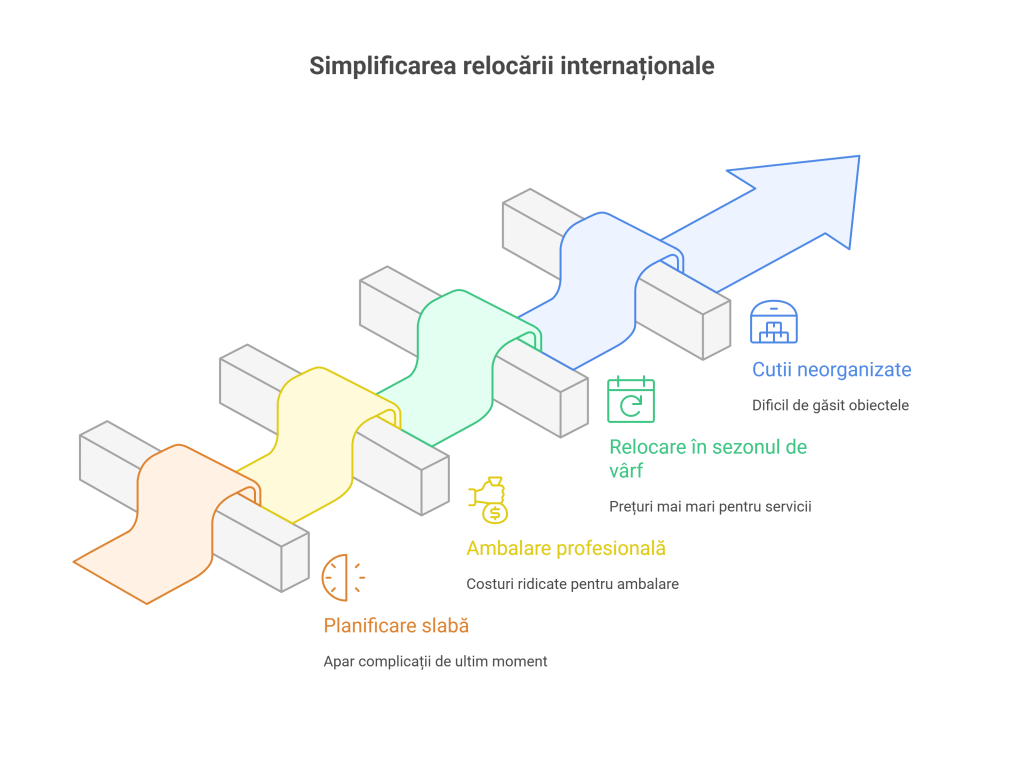
Organizing ahead of time is the key to an effective move. It is essential to have a relocation strategy and work plan. At the same time, communicate the moving date and schedule to everyone involved in advance to avoid last-minute complications.
Pack small items yourself if possible
To save money, you can pack small and less fragile items yourself. Use suitable materials: boxes in good condition, made of strong cardboard or sturdy plastic bags. Make sure you place your products centrally in the packaging and fill the empty space with soft, shock-absorbent materials.
Avoid weekend or peak season moves
Prices for relocation services are often higher during weekends and peak season. Therefore, planning your move during the week or in the off-season can significantly reduce overall costs.
Use standard boxes and clear labels
Standard cardboard boxes are the most common and versatile options available for moving. Don't forget to label each box with information about contents and destination (e.g. kitchen, bedroom). For fragile items, mark the boxes with a distinguishing mark such as the word 'fragile' on at least two sides so that they are visible even when the boxes are stacked.
Conclusion
Moving internationally is undoubtedly both logistically and financially challenging. As we have seen, the costs vary considerably depending on the distance, the volume of goods, the type of transportation chosen and the additional services contracted. A shipment from Romania to Germany can cost between €1800 and €3000, but this amount is only the basis of the total costs.
Planning ahead remains our most valuable ally. At least 2-3 weeks before the moving date, we can negotiate better prices and avoid weekend or peak season surcharges. In this way, we save money without compromising quality of service.
The decision between dedicated and groupage transportation should be made according to your budget and the urgency of the move. The former offers speed and increased safety, while the latter significantly reduces costs for smaller volumes of goods.
Transparent communication with the relocation company is essential. Questions about services included, hidden costs, insurances and policies in case of delay or damage help avoid unpleasant surprises. At the same time, packing small items yourself and using standard boxes can reduce extra costs.
At the end of the day, a successful international relocation depends on balancing budget and service quality. Prices in 2026 reflect current economic realities, but the strategies outlined in this article allow us to effectively manage this important transition in our lives.
Whether we choose to relocate for work, study or personal reasons, detailed information about costs and the factors that influence them helps us to make informed decisions and make the relocation process a less stressful and more organized experience.
Frequently Asked Questions (FAQ)

Founder and CEO of Paneuropa Logistics
I am György Bokor, Founder and CEO of Paneuropa Logistics. I have been active in the logistics industry for more than 20 years, focusing on international transportation, freight forwarding, last-mile deliveries and customs services. I am passionate about developing efficient solutions that connect businesses across Europe.