
Cheap road transport is often perceived as a quick fix for reducing costs, but in reality it can lead to significant losses in the long term. Large price differences between carriers hide very different approaches to cost calculation, compliance levels, and service quality. Here are the key points you need to consider:
- Transportation costs can account for 40–70% of operating expenses—decisions based solely on price can amplify losses over time.
- Only 10% of transport companies in Romania are profitable – many accept rates below actual cost (€0.70/km vs. ~€1/km) to keep their trucks running.
- Cheap transport often hides additional costs: handling, demurrage, customs duties, peak surcharges, or special transport.
- The increase in diesel prices and operating costs has completely changed the price structure – in some European countries, the actual cost reaches ~€1.26/km.
- Lack of insurance, old vehicles, and unqualified drivers increase the risk of damage, delays, and legal problems.
- In international transport, low prices often lead to border blockages, incomplete documentation, and non-compliance with EU regulations.
- Operational issues directly affect customer relationships: complaints, loss of trust, compensation, and return costs.
Understanding these factors helps you accurately evaluate transportation offers and choose sustainable logistics partners capable of providing stability, predictability, and continuity for your business in the long term.
Road transport costs can account for between 40% and 70% of a company's total operating expenses. This impressive figure leads many managers to seek out the cheapest options available on the market. Although road transport is considered the cheapest means of shipping goods compared to ships or planes, choosing based solely on price can hide unexpected costs in the long run.
Road transport in Poland and Romania is one of the most popular means of land freight transport. In fact, road transport is considered the fastest and most flexible way to transport goods. In the case of international road transport, compared to other forms of transport, such as sea or rail, the advantage is usually greater punctuality and more accurate scheduling of delivery dates. However, after the pandemic, the price of diesel rose by 50%, and the conflict in Ukraine added almost 50% more, which fundamentally changed the efficiency calculations.
In this article, we will examine why cheap transport can become the most expensive option in the long run and how you can avoid the pitfalls of decisions based solely on price. We will analyze the hidden risks, the impact on customer relationships, and the essential criteria for selecting a reliable road freight transport provider.
Why low prices don't always mean savings
The lure of low prices in road transport often becomes a financial trap for companies that fail to analyze the long-term implications. The phenomenon of "cheap now, expensive later" is a reality that profoundly affects the efficiency of supply chains in Romania and Europe.
Why low prices don't always mean savings
Common cases where cheap becomes expensive
A worrying phenomenon in the road freight transport industry is the large number of carriers who accept rates below the actual cost. Of the approximately 41,500 transport companies in existence, only 10% actually make a profit. Many companies accept trips at rates of €0.70/km, even though the actual costs are around €1/km. The main reason? They prefer to keep their trucks moving rather than idle.
This strategy creates a vicious circle in the market. In 2023, the profit margin in road transport was only 2%. What is even more alarming is that trips that cost €2,400 during the pandemic have fallen to €1,800, even though operating costs have risen significantly.
Hidden costs are another major problem. These are additional expenses that are not explicitly mentioned in the initial offer or that are listed in small print without being clearly explained to the beneficiary. These costs can arise at various stages of the logistics chain and may include:
- Handling fees for loading and unloading
- Demurrage (fee for exceeding the free time allocated to containers)
- Unanticipated customs duties
- Surcharges for peak periods or urgent deliveries
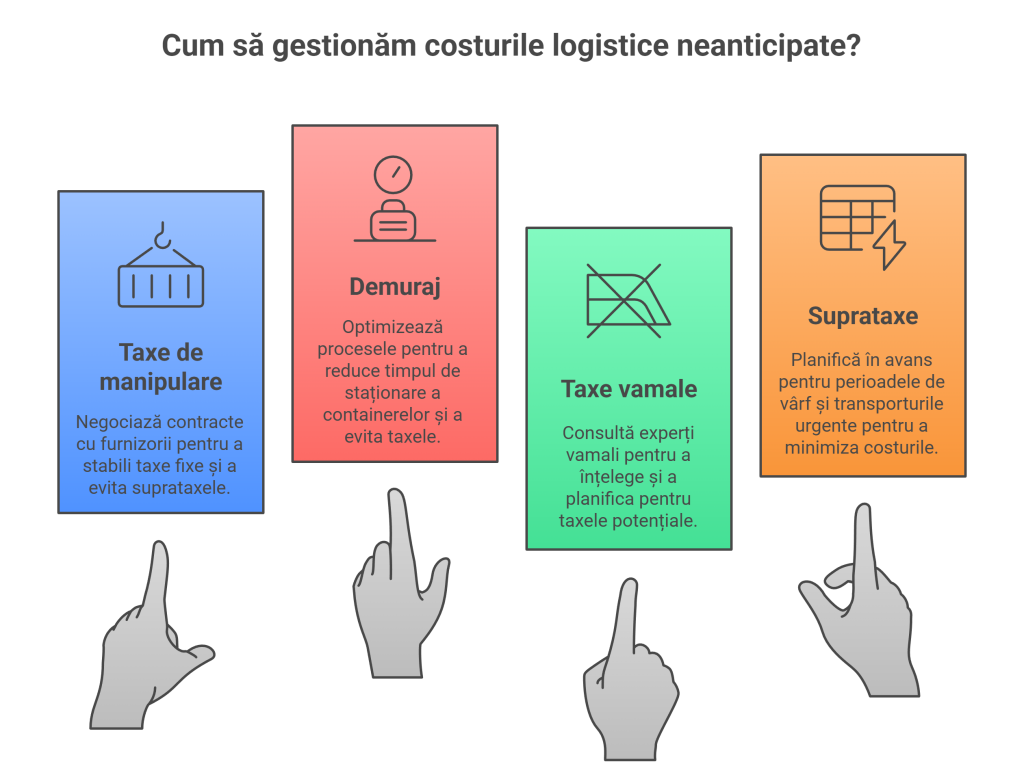
In addition, transporters are facing dramatic increases in operating costs. Fuel prices have risen by around 40% over the past year, truck parts prices have increased by around 25%, and compulsory insurance can cost up to three times more.
How prices are formed in road freight transport
Prices in road freight transport are influenced by numerous interconnected factors. Many believe that the price of transport is calculated solely on the basis of cost components (fuel, driver's salary, truck cost), but the reality is much more complex.
The cost components for a carrier include:
- Driver's salary
- Fuel cost
- Truck rental or depreciation (1.20 lei/km)
- Vehicle maintenance and tires (0.102 lei/km)
- Toll fees
- Transport licenses
- Liability insurance
Distance directly influences the cost of transport, with a proportional relationship between the number of kilometers traveled and the final price. However, the greater the distance, the cheaper the price per kilometer often becomes, as fixed costs (loading, administration) are spread over a greater distance.
After the pandemic, the price of diesel rose by 50%, and the conflict in Ukraine added almost 50% more. As a result, the average cost per kilometer for a truck traveling approximately 160,000 km/year reaches €0.312/km, including all operating expenses.
Other additional fees that affect the final price include:
- Fuel surcharge (BAF)
- Dangerous goods fee (ADR)
- Refrigerated transport fee
- Terminal and cargo handling charges
In countries such as Germany, Austria, and Hungary, road costs have increased by at least 18% in recent years, raising total operating costs to approximately €1.26/km. In Romania, changes to the road tax will come into effect in 2026, with an estimated sixfold increase for trucks traveling on Romanian national roads and highways.
A realistic calculation of road transport costs must include both direct and indirect expenses, with the latter accounting for approximately 10% of the total, plus a 5% profit margin for long-term business sustainability.
The unforeseen risks of cheap road transport
Choosing a carrier based solely on low price can lead to a series of problems that far exceed the initial savings. These unforeseen risks often turn an apparently inexpensive shipment into a considerable financial burden.
Lack of insurance and coverage in case of damage
Carriers offering very low prices often save money by reducing essential insurance coverage. First, although MTPL is mandatory, many companies avoid taking out vital complementary insurance to protect goods. Eurotrans carrier liability insurance, which covers risks such as theft or delayed delivery of goods, is frequently omitted to reduce costs.
Similarly, CARGO AȘ insurance, which protects goods in transit in the event of fire, explosion, or overturning of the means of transport, is an essential protection that is often sacrificed by low-cost carriers. Thus, in the event of an incident, the entire liability for damages may fall on the shipper, generating unexpected costs and complicated legal proceedings.
Old and non-compliant vehicles
According to recent statistics, of the 800,000 trucks registered in Romania, only 275,000 have up-to-date periodic technical inspections. Therefore, approximately two-thirds of freight vehicles are operating in uncertain or non-compliant technical conditions.
The most common problems identified during technical inspections are related to braking and steering systems. What is more, these technical faults contribute to approximately 5% of road accidents involving freight transport. In 2016, the Romanian Police recorded 70 accidents involving goods vehicles, many of which could have been prevented by proper technical inspections.
Unqualified drivers or unreliable subcontractors
Hiring a driver without an individual employment contract or without a certificate attesting to their professional competence is punishable by a fine of between 9,000 and 12,000 lei. In addition, the State Inspectorate for Road Transport Control also suspends the certified copy of the transport license for a period of 30 days.
However, some carriers offering very low prices risk these penalties in order to reduce the costs of skilled personnel. Another worrying aspect is the use of so-called "ghost carriers" as subcontractors, which have caused a significant number of incidents and damage in recent years. These unreliable subcontractors may disappear after picking up the goods, leaving substantial damage and complex legal responsibilities for the shipper.
In addition, the poor working conditions of drivers employed by low-cost transport companies contribute to additional risks. A recent study shows that 24% of truck drivers are obese (compared to 16% in the general population) and 38% smoke daily. These health problems, caused by lifestyle and working conditions, can affect drivers' attention and their ability to react in emergency situations.
How cheap transportation affects customer relations
Strong business relationships are built on trust and quality service, but cheap road transport can seriously affect these relationships due to the problems it frequently causes. The consequences are directly reflected in end customer satisfaction and the reputation of your business.
Frequent delays and lack of predictability
All the instability of recent years has led to major disruptions in the road transport industry, affecting the predictability of services. Every delayed shipment can disrupt downstream production or retail sales, inevitably leading to dissatisfied customers. For B2B manufacturers and wholesalers, unsatisfactory delivery service can strain customer relationships or result in substantial fines.
In the context of international road transport, recent events have further complicated the situation. For example, the blockage of the Suez Canal caused massive delays and significant losses, forcing carriers to find new routes and approaches to meet demand. As a result, many companies have lost credibility with their customers due to their inability to meet promised deadlines.
Complaints and loss of trust
A high damage rate directly affects customer satisfaction and can irreparably damage their trust. In the case of B2B shipments, damage to critical components can completely shut down a production line, generating additional costs for the customer. This puts strain on relationships with carriers—frequent complaints cause carriers to review how goods are packaged or even refuse certain shipments.
In the real world, when incidents occur, the carrier has a choice between destroying the business relationship and moving forward while accepting the loss, with most preferring the latter option. This situation undermines the professionalism of the entire road freight transport sector.
Compensation costs and returns
Incidents such as damage to cargo or loss of goods during transport are not isolated. They result in substantial additional costs: replacement of goods, fines from customers, urgent reshipments, and insurance claims. Furthermore, in the event of damage, invoices are blocked and no longer paid, further complicating the financial situation.
According to the CMR Convention, compensation for partial loss of goods is calculated based on their value at the place and time of admission to transport. However, for partial damage, the carrier is only compensated for a proportionate part of the cost of transport, which means that both parties suffer financial losses.
Road freight transport that appears inexpensive can thus generate massive hidden costs, turning an initial saving into a long-term loss, both financially and in terms of reputation with customers.
International road transport: the pitfalls of low prices
In international road transport, the challenges become exponentially more complex than in domestic transport. When vehicles cross borders, new obstacles arise that turn an apparently attractive price into a logistical and financial nightmare.
Customs duties and missing documents
To begin with, the EU has decided to eliminate the €150 threshold for customs duty exemption starting in 2026, a measure that is essential for combating the undervaluation of goods sold online. Statistics show that up to 65% of small parcels entering the EU are intentionally undervalued to avoid paying customs duties. Furthermore, at the European level, the number of parcels containing low-value goods doubled in 2024, reaching an impressive 4.6 billion, of which over 90% came from China.
Low-cost carriers rarely provide adequate support for complex customs documentation management, resulting in costly delays and substantial fines.
Problems crossing borders
At Romania's borders with Bulgaria, especially at the Giurgiu-Ruse and Calafat-Vidin crossing points, kilometer-long queues of trucks frequently form. Drivers end up stuck in their vehicles for over 72 hours, significantly affecting the planning of the entire logistics chain. Each day lost in these traffic jams has a devastating knock-on effect on the economy: exceeding daily driving times, additional fuel consumption, delays in the delivery of goods, and potential penalties.
As a result, low-cost carriers do not have the resources to deal with these unforeseen situations, leaving customers to bear the consequences.
Non-compliance with EU regulations
The RO e-Transport national system monitors road transport within Romania, including international transport. The obligation to declare in this system lies with the sender for exports, the beneficiary for intra-Community acquisitions, and the supplier for intra-Community deliveries. Failure to comply with these obligations results in fines ranging from 10,000 lei to 50,000 lei for individuals and from 20,000 lei to 100,000 lei for legal entities.
The transport operator is also required to ensure the transfer of vehicle positioning data throughout the entire route, and the driver must present the documents accompanied by the UIT code at the request of the authorities.
Carriers offering unrealistically low prices often fail to comply with these complex regulations, transferring compliance risks and potential fines to service recipients.
How to choose a long-term road freight transport provider
Selecting a reliable road freight partner can make the difference between success and failure in the logistics chain. Here's how to identify a trustworthy supplier for long-term collaboration.
What questions to ask before signing
Before signing the contract, check whether the carrier offers insurance for the goods in case of theft or fire. Also, inquire about real-time tracking systems and the possibility of receiving notifications about the location of the goods en route. It is essential to clarify all costs involved, including the price of transportation itself, handling, and storage, to avoid hidden fees that can triple the final price.
The importance of history and reviews
The best option is to get recommendations from acquaintances who are satisfied with the quality of services. Alternatively, consult online reviews, but filter them carefully. The Trans.EU platform allows for detailed verification of carriers, as only users who have actually worked with the operator can add ratings for punctuality, communication, and integrity of goods.
License and fleet verification
Always check the carrier's documents on the official website of the Romanian Road Authority (A.R.R). This step confirms that the entity has the necessary licenses for international road transport. The quality of the fleet says a lot about the company's reliability—old vehicles are more prone to technical failures, which can affect the safety of the goods.
Conclusion
Choosing a transport partner based solely on price is undoubtedly a risky strategy for any business. As we have seen throughout this article, cheap transport often hides additional costs that far exceed the initial savings. The dumping prices of €0.70/km, practiced by many carriers desperate to keep their trucks moving, are unsustainable in the long term and create a vicious circle throughout the industry.
Hidden costs, inadequate insurance, and the use of older vehicles quickly turn apparent savings into substantial losses. What's more, the damage to your customer relationships can be irreparable. Delays, damaged goods, and unpredictability erode hard-earned trust, directly affecting the profitability of your business.
International transport adds an extra layer of complexity, with customs issues, border delays, and strict EU regulations. Therefore, selecting a logistics partner must become a strategic process, not just a decision based on the lowest price offered.
The correct approach is to thoroughly check potential transport providers. Questions about insurance, monitoring systems, and the fleet used should become standard practice. Authentic reviews and the company's history also provide valuable insights into its long-term reliability.
Therefore, the lowest price can paradoxically become the most expensive choice. A quality transport partner is an investment in the stability and growth of your business, not just an operating cost to be minimized. Making a wise choice today will prevent numerous problems and unexpected expenses tomorrow.
Frequently asked questions about cheap road transport and its risks

Founder and CEO of Paneuropa Logistics
I am György Bokor, Founder and CEO of Paneuropa Logistics. I have been active in the logistics industry for more than 20 years, focusing on international transportation, freight forwarding, last-mile deliveries and customs services. I am passionate about developing efficient solutions that connect businesses across Europe.