
FORMAL COMPLIANCE GUIDE
International transport – applicable from July 1, 2026
Document drafted on: February 26, 2026
The obligation to equip 2.5–3.5 t vehicles used in international transport with tachographs brings major changes for operators in Romania starting July 1, 2026. The extension of the rules through Mobility Package I means not only the installation of technical equipment, but also strict compliance with the rules on driving times, posting, and the remuneration of drivers. Here are the main key points you need to consider:
- From July 1, 2026, vehicles weighing 2.5–3.5 tons used in international transport or cabotage must be equipped with a second-generation smart tachograph (Smart Tachograph G2V2).
- The obligation applies to companies engaged in international freight transport or cabotage operations in the EU.
- The installation, calibration, and sealing of the tachograph must be carried out in authorized workshops, and the data must be downloaded and archived periodically.
- Compliance with driving times, breaks, and rest periods in accordance with European legislation becomes mandatory.
- Operators must hold a Community License and a certified copy for each vehicle used in international transport for hire or reward.
- For cabotage and cross-trade, it is necessary to submit the posting declaration through the IMI system before carrying out the operation.
- Posted drivers must be remunerated in accordance with the minimum level applicable in the host Member State, based on the principle of "equal pay for equal work."
- The company must keep clear records of the hours worked in each state, salary calculations, and supporting documents.
- Failure to comply with obligations may result in fines, immobilization of the vehicle, or suspension of the right to operate.
- It is recommended to implement an internal monitoring and periodic audit system to prevent legal and financial risks.
Early adoption of the necessary technical and administrative measures will reduce the risk of penalties and ensure the continuity of international transport operations after July 1, 2026.
This document is a formal compliance guide for road freight transport operators in Romania who use vehicles with a maximum authorized mass (MAM) between 2.5 and 3.5 tons and carry out international transport or cabotage operations within the European Union.
1. Applicable legislative framework
Starting July 1, 2026, vehicles with a maximum authorized mass (MAM) between 2.5 and 3.5 tons used for international freight transport or cabotage operations will be required to be equipped with a second-generation smart tachograph (Smart Tachograph v2 – G2V2).
The application of this obligation derives from the changes introduced by Mobility Package I, which extend the applicability of social rules (driving and rest times) to light commercial vehicles used in cross-border operations.
At the national level, enforcement and penalties are based on Government Ordinance No. 37/2007 and the related regulations of the Romanian Road Authority (ARR).
2. Obligations regarding the tachograph
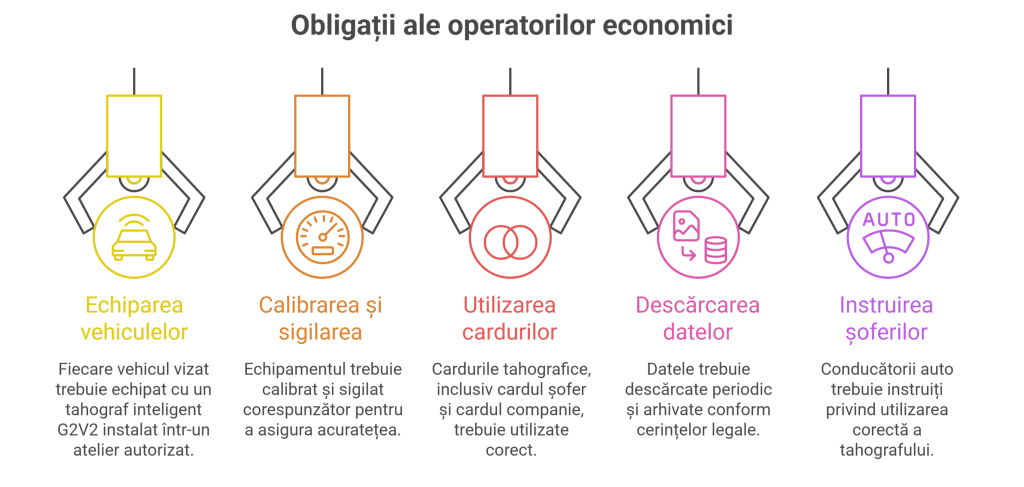
Economic operators must ensure the following:
- Equipping each vehicle concerned with a G2V2 smart tachograph installed in an authorized workshop;
- Proper calibration and sealing of equipment;
- Proper use of tachograph cards (driver card and company card);
- Periodic downloading and archiving of data in accordance with legal requirements;
- Training drivers on the correct use of the tachograph.
Failure to comply with these obligations may result in administrative penalties, immobilization of the vehicle, or suspension of the right to operate.
3. Rules on driving and rest times
With the introduction of the tachograph, the vehicles concerned are subject to rules on driving times, breaks, and rest periods. The operator is responsible for organizing the activity so that:
- The maximum daily and weekly driving times must be observed;
- Mandatory breaks must be taken in accordance with regulations;
- Daily and weekly rest periods shall be granted accordingly;
- The recorded data should reflect the reality of the activities carried out.
The company must implement internal procedures for periodic verification and control of downloaded data.
4. Licensing and mandatory documents
For international transport for hire or reward with vehicles weighing 2.5–3.5 tons, it is necessary to hold a Community License and a certified copy for each vehicle.
The documents must be kept on board and presented for inspection at the request of the competent authorities.
5. Posting of Drivers
In the case of certain types of international transport (cabotage, cross-trade transport), the operator is required to submit the posting declaration via the portal connected to the IMI system.
The declaration must be submitted prior to the operation in question and must contain the operator's details, the driver's details, the period of posting, and the host Member State.
The driver must be able to present proof of registration of the declaration, as well as supporting documents relating to the transport operation, during checks.
6. Remuneration in accordance with the rules on secondment
During the period of posting in a Member State, the driver is entitled to the remuneration applicable in the host country, in accordance with the principle of 'equal pay for equal work'.
The operator must ensure that the total remuneration paid to the driver for the period of posting is not lower than the minimum level set in the Member State concerned.
Salary elements may include base salary, specific allowances, bonuses, and other mandatory components in accordance with the legislation of the host country.
Secondment allowances may be considered part of remuneration only to the extent that they do not represent reimbursement of expenses (transport, accommodation, meals).
The operator must keep clear records of salary calculations, hours worked in each state, and related supporting documentation.
7. Recommended internal organization
To ensure compliance, it is recommended that a person be designated to monitor tachographs, manage cards, submit IMI declarations, and verify compliance with wage rules.
It is recommended that a quarterly internal audit be conducted to verify compliance with legal obligations.
8. Conclusions
Extending the obligation to use tachographs to vehicles weighing between 2.5 and 3.5 tons represents a major change for Romanian operators engaged in international transport. Compliance requires not only the installation of technical equipment, but also the implementation of a comprehensive system for monitoring, reporting, and correctly remunerating posted drivers.
Taking the necessary measures before the July 1, 2026 deadline will reduce the risks of penalties, litigation, and commercial losses.
Frequently asked questions about the tachograph requirement for 2.5–3.5 t vehicles in international transport

Founder and CEO of Paneuropa Logistics
I am György Bokor, Founder and CEO of Paneuropa Logistics. I have been active in the logistics industry for more than 20 years, focusing on international transportation, freight forwarding, last-mile deliveries and customs services. I am passionate about developing efficient solutions that connect businesses across Europe.